FROM SMOG TO STEWARDSHIP: THE “DUAL-LOOP” GOVERNANCE MODEL FOR PLANETARY SUSTAINABILITY DRIVEN BY WOMEN’S LEADERSHIP IN FUKUOKA, JAPAN
DOI:
https://doi.org/10.46754/ps.2026.01.004Keywords:
Women’s leadership, planetary health, one health, “Dual-Loop” Governance Model, Fukuoka method, feminist political ecology.Abstract
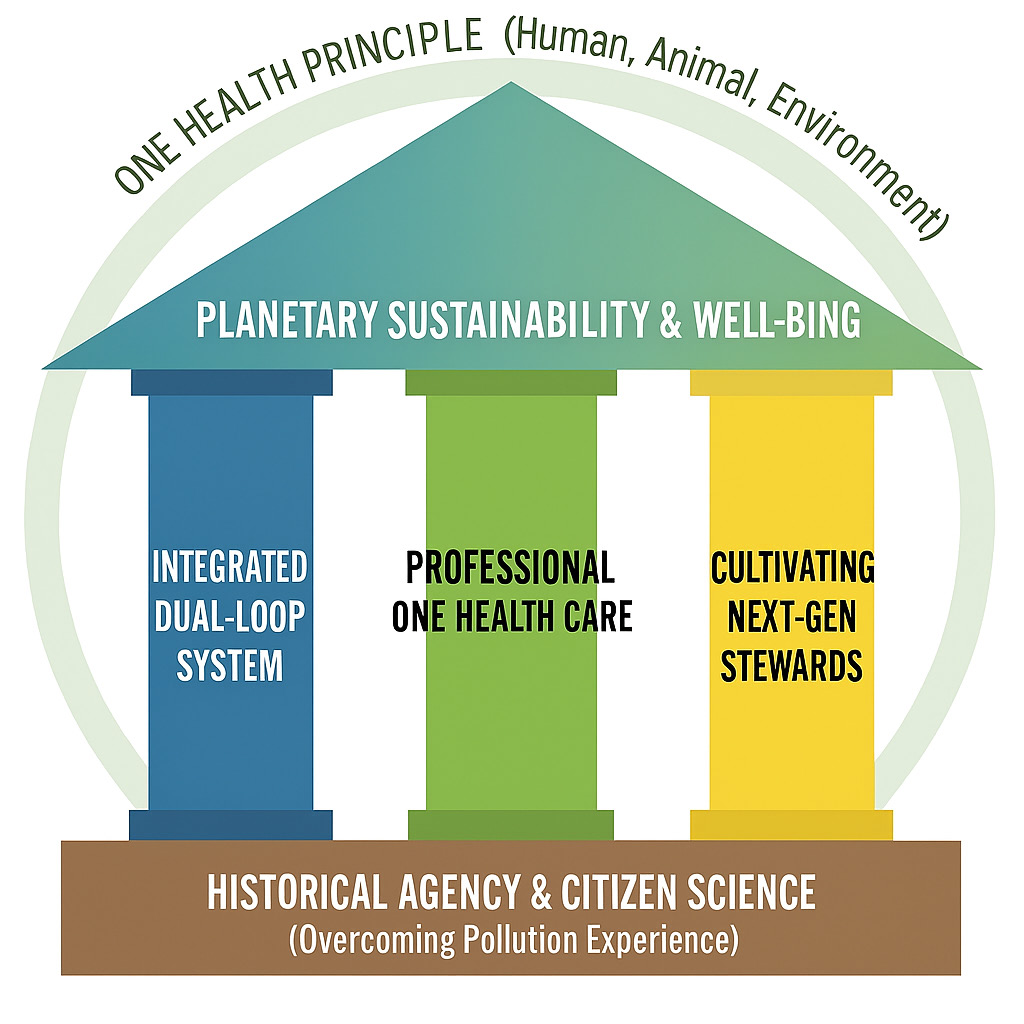
As cities worldwide confront the escalating challenges of the Anthropocene, Fukuoka, Japan, exemplifies a transformative approach shaped by both top-down directives and grassroots leadership. Notably, women have played a pivotal role in redefining environmental governance through care, scientific engagement, and entrepreneurship. This review analyses Fukuoka’s sustainability trajectory through the frameworks of planetary Health and One Health. The “Dual-Loop” Governance Model is introduced, consisting of a technological Macro Loop and a social Micro Loop. By integrating historical policy records, quantitative disaster resilience data (JDA-DAT), and educational
curricula from Fukuoka Women’s University (FWU), this article demonstrates the institutionalisation of women’s agency into professional competency. While recognising the interaction between administrative and technological factors, the analysis indicates that the Micro Loop, led by women, substantially enhances system efficacy. The Fukuoka model is presented as a potential blueprint for other Asian cities, contingent upon specific administrative capacities and community structures.
References
Colla, S. R., & MacIvor, J. S. (2017). Questioning public perception, conservation policy, and recovery actions for honeybees in North America. Conservation Biology, 31(5), 1202-1204. https://doi.org/10.1111/cobi.12839
Corburn, J. (2005). Street science: Community knowledge and environmental health justice. MIT Press.
Fujikura, R. (2007). Administrative guidance of Japanese local government for air pollution control. In Terao, T., & Otsuka, K. (Eds.), Development of environmental policy in Japan and Asian countries. IDE-JETRO Series. Palgrave Macmillan. https://doi.org/10.1057/9780230624931_5
Fukuoka Women’s University. (n.d.). Official Website of Fukuoka Women’s University. http://www.fwu.ac.jp/
Hakata Honeybee Project. (n.d.). Official Website of Hakata Honeybee Project. https://hakatamitsubachi.com/
Hirata, O., Matsufuji, Y., Tachifuji, A., & Yanase, R. (2012). Waste stabilization mechanism by a recirculatory semi-aerobic landfill with the aeration system. Journal of Material Cycles and Waste Management, 14, 47-51. https://doi.org/10.1007/s10163-011-0036-7
Hulme, M. (2017). The Fukuoka Method: Community-based Solid Waste Management. JICA Report.
Japan Dietetic Association. (2023). Membership Statistics. https://www.dietitian.or.jp/
Nakamura, T. (2002). Japan’s Environmental Movement: The Case of the Kitakyushu Area. Review of Kitakyushu University.
Rocheleau, D., Thomas-Slayter, B., & Wangari, E. (1996). Feminist political ecology: Global issues and local experience. Routledge.
Schroeder, P., Anggraeni, K., & Weber, U. (2019). The relevance of circular economy practices to the sustainable development goals. Journal of Industrial Ecology, 23(1), 66-75. https://doi.org/10.1111/jiec.12732
Tronto, J. C. (1993). Moral boundaries: A political argument for an ethic of care. Routledge.
Tsuboyama-Kasaoka, N. (2018). Disaster nutrition and the Japan Dietetic Association-Disaster Assistance Team (JDA-DAT). Journal of the National Institute of Public Health, 67(1), 84-90.
UN-Habitat. (2020). Circular economy in cities: A practitioner’s guide. United Nations Human Settlements Programme. https://digitallibrary.un.org/record/4032560
Whitmee, S., Haines, A., Beyrer, C., Boltz, F., Capon, A. G., de Souza Dias, B. F., Ezeh, A., Frumkin, H., Gong, P., Head, P., Horton, R., Mace, G. M., Marten, R., Myers, S. S., Nishtar, S., Osofsky, S. A., Pattanayak, S. K., Pongsiri, M. J., Romanelli, C., Soucat, A., Vega, J., & Yach, D. (2015). Safeguarding human health in the Anthropocene epoch: Report of The Rockefeller Foundation–Lancet Commission on planetary health. The Lancet, 386(10007), 1973-2028. https://doi.org/10.1016/S0140-6736(15)60901-1
Zinsstag, J., Schelling, E., Waltner-Toews, D., & Tanner, M. (2011). From “one medicine” to “one health” and systemic approaches to health and well-being. Preventive Veterinary Medicine, 101(3-4), 148-156. https://doi.org/10.1016/j.prevetmed.2010.07.003
Downloads
Published
Issue
Section
License
Copyright (c) 2026 Planetary Sustainability

This work is licensed under a Creative Commons Attribution-ShareAlike 4.0 International License.