WHY AQUACULTURE MUST REDUCE ITS DEPENDENCE ON FISHMEAL
DOI:
https://doi.org/10.46754/ps.2026.01.003Keywords:
Aquaculture, fishmeal, sustainability, alternative feeds, food security, circular bioeconomy.Abstract
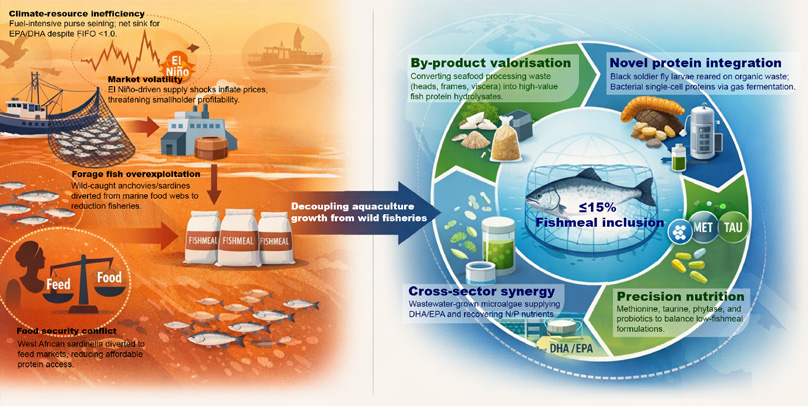
Aquaculture, as the world’s fastest-growing food production sector is indispensable for global food security and nutrition. Yet, its environmental and economic sustainability is critically jeopardised by a deep-seated reliance on fishmeal, a finite resource derived from wild-caught forage fisheries. This comprehensive review argues that reducing this dependency is an urgent imperative, synthesising evidence from 2020 onward across environmental, economic, and social dimensions. The overexploitation of small pelagic fish for reduction to meal disrupts marine trophic webs, compromises ecosystem resilience, and conflicts with direct human consumption needs in vulnerable regions. Economically, it binds the industry to volatile commodity markets, threatening profitability and stability. The article meticulously evaluates the scientific and commercial progress in alternative proteins, including precision-formulated plant blends, insect meals, single-cell proteins, and by-product valorisation, demonstrating that viable pathways exist. Through detailed case studies and policy analysis, it concludes that a systemic transition toward circular aquafeed systems is not only feasible but essential. This transition, supported by coherent policy, targeted R&D, and market incentives, is the key to unlocking aquaculture’s potential as a truly sustainable, resilient, and equitable pillar of the future global food system, aligning with the United Nations (UN) Sustainable Development Goals.
References
Ahmad, A., Hassan, S. W., & Banat, F. (2022). An overview of microalgae biomass as a sustainable aquaculture feed ingredient: Food security and circular economy. Bioengineered, 13(4), 9521-9547. https://doi.org/10.1080/21655979.2022.2061148 DOI: https://doi.org/10.1080/21655979.2022.2061148
BioMar. (2003). ASC Feed Standard. Retrieved from https://www.biomar.com/insights/insights-hub/asc-feed-standard
Boyd, C. E., McNevin, A. A., & Davis, R. P. (2022). The contribution of fisheries and aquaculture to the global protein supply. Food Security, 14(3), 805-827. https://doi.org/10.1007/S12571-021-01246-9 DOI: https://doi.org/10.1007/s12571-021-01246-9
Bu, X., Li, Y., Lai, W., Yao, C., Liu, Y., Wang, Z., Zhao, Z., Han, S., Du, J., Yao, X., Mai, K., & Ai, Q. (2024). Innovation and development of the aquaculture nutrition research and feed industry in China. Reviews in Aquaculture, 16(2), 759-774. https://doi.org/10.1111/RAQ.12865 DOI: https://doi.org/10.1111/raq.12865
Chamodi, K. K. D., Vu, N. T., Domingos, J. A., Loh, J.-Y., Chamodi, K. K. D., Vu, N. T., Domingos, J. A., & Loh, J.-Y. (2025). Cellular solutions: Evaluating single-cell proteins as sustainable feed alternatives in aquaculture. Biology, 14(7). https://doi.org/10.3390/BIOLOGY14070764 DOI: https://doi.org/10.3390/biology14070764
Chi, G., Xu, Y., Cao, X., Li, Z., Cao, M., Chisti, Y., & He, N. (2022). Production of polyunsaturated fatty acids by Schizochytrium (Aurantiochytrium) spp. Biotechnology Advances, 55, 107897. https://doi.org/10.1016/J.BIOTECHADV.2021.107897 DOI: https://doi.org/10.1016/j.biotechadv.2021.107897
Das, S. K., Mondal, B., Sarkar, U. K., Das, B. K., & Borah, S. (2023). Understanding and approaches towards circular bio-economy of wastewater reuse in fisheries and aquaculture in India: An overview. Reviews in Aquaculture, 15(3), 1100-1114. https://doi.org/10.1111/RAQ.12758 DOI: https://doi.org/10.1111/raq.12758
Deb, P. (2025). From feed to fish: The impact of input factor and uncertainty shocks in Bangladesh aquaculture market. Aquaculture Economics and Management, 30(1), 28-49. https://doi.org/10.1080/13657305.2025.2494588 DOI: https://doi.org/10.1080/13657305.2025.2494588
Esmaeily, A., Mohammadi, P., Ishak, S., Liew, H. J., Chang, J.-J., Wei, H. C., & Tabatabaei, M. (2026). Protein recovery and utilization from aquatic resources. In Amiri, H., Tabatabaei, M., Aghbashlo, M., & Ikhwanuddin, M. (Eds.), Aquatic resource biorefineries. Elsevier.
Essington, T. E., Moriarty, P. E., Froehlich, H. E., Hodgson, E. E., Koehn, L. E., Oken, K. L., Siple, M. C., & Stawitz, C. C. (2015). Fishing amplifies forage fish population collapses. Proceedings of the National Academy of Sciences of the United States of America, 112(21), 6648-6652. https://doi.org/10.1073/PNAS.1422020112 DOI: https://doi.org/10.1073/pnas.1422020112
FAO. (2022a). Record Fisheries and Aquaculture Production Makes Critical Contribution to Global Food Security. https://www.fao.org/newsroom/detail/record-fisheriesaquaculture-production-contributes-foodsecurity-290622/en
FAO. (2022b). The State of World Fisheries and Aquaculture 2022 Towards Blue Transformation. https://doi.org/10.4060/CC0461EN DOI: https://doi.org/10.4060/cc0461en
Fry, J. P., Mailloux, N. A., Love, D. C., Milli, M. C., & Cao, L. (2018). Feed conversion efficiency in aquaculture: Do we measure it correctly? Environmental Research Letters, 13(2), 024017. https://doi.org/10.1088/1748-9326/AAA273 DOI: https://doi.org/10.1088/1748-9326/aaa273
Ghamkhar, R., & Hicks, A. (2020). Comparative environmental impact assessment of aquafeed production: Sustainability implications of forage fish meal and oil free diets. Resources, Conservation and Recycling, 161, 104849. https://doi.org/10.1016/J.RESCONREC.2020.104849 DOI: https://doi.org/10.1016/j.resconrec.2020.104849
Glencross, B. D., Huyben, D., & Schrama, J. W. (2020). The application of single-cell ingredients in aquaculture feeds—A review. Fishes, 5(3), 1-39. https://doi.org/10.3390/FISHES5030022 DOI: https://doi.org/10.3390/fishes5030022
Gudbrandsdottir, I. Y., Saviolidis, N. M., Olafsdottir, G., Oddsson, G. V., Stefansson, H., Bogason, S. G., Gudbrandsdottir, I. Y., Saviolidis, N. M., Olafsdottir, G., Oddsson, G. V., Stefansson, H., & Bogason, S. G. (2021). Transition pathways for the farmed salmon value chain: Industry perspectives and sustainability implications. Sustainability, 13(21), 12106. https://doi.org/10.3390/SU132112106 DOI: https://doi.org/10.3390/su132112106
Hamidoghli, A., Yun, H., Won, S., Kim, S. K., Farris, N. W., & Bai, S. C. (2018). Evaluation of a single-cell protein as a dietary fish meal substitute for whiteleg shrimp Litopenaeus vannamei. Fisheries Science, 85(1), 147-155. https://doi.org/10.1007/S12562-018-1275-5 DOI: https://doi.org/10.1007/s12562-018-1275-5
Henriksson, P. J. G., Troell, M., Banks, L. K., Belton, B., Beveridge, M. C. M., Klinger, D. H., Pelletier, N., Phillips, M. J., & Tran, N. (2021). Interventions for improving the productivity and environmental performance of global aquaculture for future food security. One Earth, 4(9), 1220-1232. https://doi.org/10.1016/J.ONEEAR.2021.08.009 DOI: https://doi.org/10.1016/j.oneear.2021.08.009
Henry, M., Gasco, L., Piccolo, G., & Fountoulaki, E. (2015). Review on the use of insects in the diet of farmed fish: Past and future. Animal Feed Science and Technology, 203(1), 1-22. https://doi.org/10.1016/J.ANIFEEDSCI.2015.03.001 DOI: https://doi.org/10.1016/j.anifeedsci.2015.03.001
Hussain, S. M., Bano, A. A., Ali, S., Rizwan, M., Adrees, M., Zahoor, A. F., Sarker, P. K., Hussain, M., Arsalan, M. Z., Yong, J. W. H., & Naeem, A. (2024). Substitution of fishmeal: Highlights of potential plant protein sources for aquaculture sustainability. Heliyon, 10(4), e26573. https://doi.org/10.1016/J.HELIYON.2024.E26573 DOI: https://doi.org/10.1016/j.heliyon.2024.e26573
IFFO - The Marine Ingredients Organisation. (n.d.). FIFO Data. https://www.iffo.com/fifo-data
Jannathulla, R., Rajaram, V., Kalanjiam, R., Ambasankar, K., Muralidhar, M., & Dayal, J. S. (2019). Fishmeal availability in the scenarios of climate change: Inevitability of fishmeal replacement in aquafeeds and approaches for the utilization of plant protein sources. Aquaculture Research, 50(12), 3493-3506. https://doi.org/10.1111/ARE.14324 DOI: https://doi.org/10.1111/are.14324
Li, X., Zheng, S., Cheng, K., Ma, X., & Wu, G. (2021). Use of alternative protein sources for fishmeal replacement in the diet of largemouth bass (Micropterus salmoides). Part II: effects of supplementation with methionine or taurine on growth, feed utilization, and health. Amino Acids, 53(1), 49-62. https://doi.org/10.1007/S00726-020-02922-4 DOI: https://doi.org/10.1007/s00726-020-02922-4
Malcorps, W., Kok, B., Land, M. van’t, Fritz, M., Doren, D. van, Servin, K., Heijden, P. van der, Palmer, R., Auchterlonie, N. A., Rietkerk, M., Santos, M. J., & Davies, S. J.(2019). The sustainability conundrum of fishmeal substitution by plant ingredients in shrimp feeds. Sustainability, 11(4), 1212. https://doi.org/10.3390/SU11041212 DOI: https://doi.org/10.3390/su11041212
Martínez-Ibáñez, E., Laso, J., Vázquez-Rowe, I., Ceballos-Santos, S., Fernández-Rios, A., Margallo, M., & Aldaco, R. (2024). Integrating the water-energy-food nexus and LCA + DEA methodology for sustainable fisheries management: A case study of Cantabrian fishing fleets. Science of The Total Environment, 949, 175223. https://doi.org/10.1016/J.SCITOTENV.2024.175223 DOI: https://doi.org/10.1016/j.scitotenv.2024.175223
Masi, M., Adinolfi, F., Vecchio, Y., Agnusdei, G. P., Coluccia, B., Masi, M., Adinolfi, F., Vecchio, Y., Agnusdei, G. P., & Coluccia, B. (2024). Toward the circular economy in the aquaculture sector: Bibliometric, network and content analyses. Sustainability, 16(13). https://doi.org/10.3390/SU16135405 DOI: https://doi.org/10.3390/su16135405
Maulu, S., Langi, S., Hasimuna, O. J., Missinhoun, D., Munganga, B. P., Hampuwo, B. M., Gabriel, N. N., Elsabagh, M., Van Doan, H., Abdul Kari, Z., & Dawood, M. A. O. (2022). Recent advances in the utilization of insects as an ingredient in aquafeeds: A review. Animal Nutrition, 11, 334-349. https://doi.org/10.1016/J.ANINU.2022.07.013 DOI: https://doi.org/10.1016/j.aninu.2022.07.013
Mboya, J. B. (2025). Enhancing aquaculture sustainability: The use of insect meals in fish feed. animal science cases. Animal Science Cases. https://doi.org/10.1079/ANIMALSCIENCECASES.2025.0015 DOI: https://doi.org/10.1079/animalsciencecases.2025.0015
Moy de Vitry, J. (2013). Innovating out of the fishmeal trap - A case study on how niche conditions in the Norwegian aquafeed sector led to the development of a sustainable technology with global potential. [Master’s thesis, Gothenburg University]. https://gupea.ub.gu.se/handle/2077/33377
Munguti, J., Muthoka, M., Chepkirui, M., Kyule, D., Obiero, K., Ogello, E., Madalla, N. A., & Kwikiriza, G. (2024). The fish feed sector in Kenya, Uganda, Tanzania, and Rwanda: Current status, challenges, and strategies for improvement—A comprehensive review. Aquaculture Nutrition, 8484451. https://doi.org/10.1155/2024/8484451 DOI: https://doi.org/10.1155/2024/8484451
Newton, R. W., Malcorps, W., Robinson, J. P. W., Kok, B., Little, D. C., Lofstedt, A., de Roos, B., & Willer, D. F. (2025). Fish as feed: Using the nutrient Fish In: Fish Out ratio (nFIFO) to enhance nutrient retention in aquaculture. Aquaculture, 602, 742332. https://doi.org/10.1016/J.AQUACULTURE.2025.742332 DOI: https://doi.org/10.1016/j.aquaculture.2025.742332
Ouko, K. O., Mboya, J. B., Obiero, K. O., Ogello, E. O., Mukhebi, A. W., Muthoka, M., & Munguti, J. M. (2023). Determinants of fish farmers’ awareness of insect-based aquafeeds in Kenya; The case of black soldier fly larvae meal. Cogent Food and Agriculture, 9(1). https://doi.org/10.1080/23311932.2023.2187185 DOI: https://doi.org/10.1080/23311932.2023.2187185
Pereira, A. G., Fraga-Corral, M., Garcia-Oliveira, P., Otero, P., Soria-Lopez, A., Cassani, L., Cao, H., Xiao, J., Prieto, M. A., Simal-Gandara, J., Pereira, A. G., Fraga-Corral, M., Garcia-Oliveira, P., Otero, P., Soria-Lopez, A., Cassani, L., Cao, H., Xiao, J., Prieto, M. A., & Simal-Gandara, J. (2022). Single-cell proteins obtained by circular economy intended as a feed ingredient in aquaculture. Foods, 11(18). https://doi.org/10.3390/FOODS11182831 DOI: https://doi.org/10.3390/foods11182831
Pikitch, E. K., Rountos, K. J., Essington, T. E., Santora, C., Pauly, D., Watson, R., Sumaila, U. R., Boersma, P. D., Boyd, I. L., Conover, D. O., Cury, P., Heppell, S. S., Houde, E. D., Mangel, M., Plagányi, É., Sainsbury, K., Steneck, R. S., Geers, T. M., Gownaris, N., & Munch, S. B. (2014). The global contribution of forage fish to marine fisheries and ecosystems. Fish and Fisheries, 15(1), 43-64. https://doi.org/10.1111/FAF.12004 DOI: https://doi.org/10.1111/faf.12004
Pleić, I. L., Bušelić, I., Messina, M., Hrabar, J., Žuvić, L., Talijančić, I., Žužul, I., Pavelin, T., Anđelić, I., Pleadin, J., Puizina, J., Grubišić, L., Tibaldi, E., & Šegvić-Bubić, T. (2022). A plant-based diet supplemented with Hermetia illucens alone or in combination with poultry by-product meal: One step closer to sustainable aquafeeds for European seabass. Journal of Animal Science and Biotechnology, 13(1), 77. https://doi.org/10.1186/S40104-022-00725-Z DOI: https://doi.org/10.1186/s40104-022-00725-z
Price, C., & Egna, H. (2014). Strategies for reducing feed costs in small-scale aquaculture. Responsible Seafood Advocate. https://www.globalseafood.org/advocate/strategies-for-reducing-feed-costs-in-small-scale-aquaculture/
Robinson, J. P. W., Mills, D. J., Asiedu, G. A., Byrd, K., Mancha Cisneros, M. del M., Cohen, P. J., Fiorella, K. J., Graham, N. A. J., MacNeil, M. A., Maire, E., Mbaru, E. K., Nico, G., Omukoto, J. O., Simmance, F., & Hicks, C. C. (2022). Small pelagic fish supply abundant and affordable micronutrients to low- and middle-income countries. Nature Food, 3(12), 1075-1084. https://doi.org/10.1038/s43016-022-00643-3 DOI: https://doi.org/10.1038/s43016-022-00643-3
Serra, V., Pastorelli, G., Tedesco, D. E. A., Turin, L., & Guerrini, A. (2024). Alternative protein sources in aquafeed: Current scenario and future perspectives. Veterinary and Animal Science, 25, 100381. https://doi.org/10.1016/J.VAS.2024.100381 DOI: https://doi.org/10.1016/j.vas.2024.100381
Sprague, M., Betancor, M. B., & Tocher, D. R. (2017). Microbial and genetically engineered oils as replacements for fish oil in aquaculture feeds. Biotechnology Letters, 39(11), 1599-1609. https://doi.org/10.1007/S10529-017-2402-6 DOI: https://doi.org/10.1007/s10529-017-2402-6
Van Putten, I., Longo, C., Arton, A., Watson, M., Anderson, C. M., Himes-Cornell, A., Obregón, C., Robinson, L., & Van Steveninck, T. (2020). Shifting focus: The impacts of sustainable seafood certification. PLOS ONE, 15(6), e0235602. https://doi.org/10.1371/JOURNAL.PONE.0233237 DOI: https://doi.org/10.1371/journal.pone.0235602
Verreth, J. A. J., Roy, K., & Turchini, G. M. (2023). Circular bio-economy in aquaculture. Reviews in Aquaculture, 15(3), 944-946. https://doi.org/10.1111/RAQ.12812 DOI: https://doi.org/10.1111/raq.12812
VN Seafood Insider. (2025). Inside Vietnam Pangasius Farming: Every Importer Must Know. https://vnseafoodinsider.com/vietnam-pangasius-farming/
Wachira, M. N., Osuga, I. M., Munguti, J. M., Ambula, M. K., Subramanian, S., Tanga, C. M., Wachira, M. N., Osuga, I. M., Munguti, J. M., Ambula, M. K., Subramanian, S., & Tanga, C. M. (2021). Efficiency and improved profitability of insect-based aquafeeds for farming Nile tilapia fish (Oreochromis niloticus L.). Animals, 11(9). https://doi.org/10.3390/ANI11092599 DOI: https://doi.org/10.3390/ani11092599
Downloads
Published
How to Cite
Issue
Section
License
Copyright (c) 2026 Planetary Sustainability

This work is licensed under a Creative Commons Attribution-ShareAlike 4.0 International License.