CAN HYDROTHERMAL BIOMASS PROCESSING SERVE AS AN ANALOGUE OF MILLENNIA-SCALE NATURAL CARBON MATURATION? A UNIFIED PERSPECTIVE ON CARBONISATION, HUMIFICATION, AND FULVIFICATION
DOI:
https://doi.org/10.46754/ps.2026.01.002Keywords:
Hydrothermal carbonisation, hydrothermal humification, artificial humic acids, artificial peat, carbon maturation.Abstract
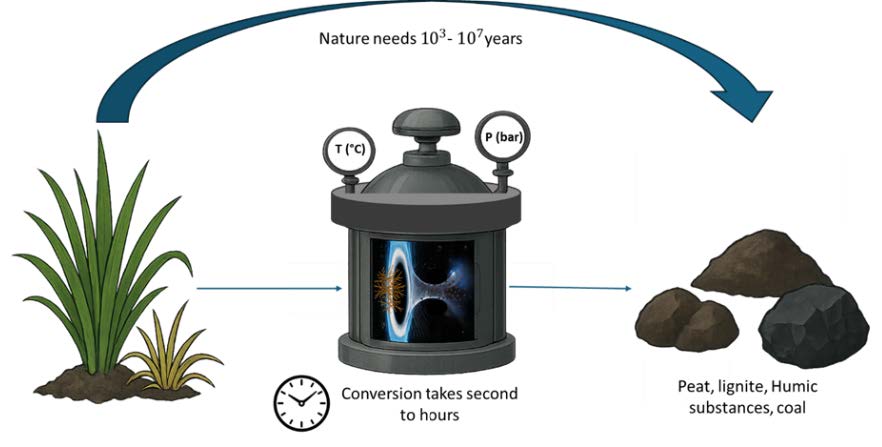
Hydrothermal biomass processing provides a rapid and controllable approach to replicating the natural carbon maturation of organic matter, a process that typically spans millennia. Subcritical water treatment at elevated temperatures and pressures converts biomass into products analogous to those found in peat, lignite, and coal. This review examines three principal hydrothermal pathways, namely carbonisation, humification, and fulvification, which yield hydrochar, artificial humic acids, and fulvic-like acids, respectively. These products share similarities with natural soil organic matter in terms of carbon content, polarity, and stability. The Van Krevelen diagram serves as a valuable tool for comparing the transformation trajectories of these materials with those of natural carbon evolution. Analysing the effects of process variables such as temperature, pH, and feedstock composition facilitates the development of tailored carbon materials for soil amendment, peat substitution, and carbon sequestration. The review also addresses technological challenges and scaleup requirements to advance future bioeconomy applications.
References
Akiya, N., & Savage, P. E. (2002). Roles of water for chemical reactions in high-temperature water. Chemical Reviews, 102, 2725-2750.
Almendros, G., & González-Pérez, J. A. (2025). Soil organic carbon sequestration mechanisms and the chemical nature of soil organic matter—A review. Sustainability, 17, 6689. https://doi.org/10.3390/su17156689
Amir, S., Hafidi, M., Lemee, L., Merlina, G., Guiresse, M., Pinelli, E., Revel, J.-C., Bailly, J.-R., & Ambles, A. (2006). Structural characterization of humic acids, extracted from sewage sludge during composting, by thermochemolysis–gas chromatography–Mass spectrometry. Process Biochemistry, 41, 410-422. https://doi.org/10.1016/j.procbio.2005.07.005
Antu, U. B., Roy, T. K., Kulsum, T. I., Mitu, P. R., Ismail, Z., Arifin, M., Datta, M., Hossain, S. A., Islam, M. S., Mahiddin, N. A., Al Bakky, A., Hossin, S., Islam, S., & Idris, A. M. (2025). Role of humic acid for climate change adaptation measures to boost up sustainable agriculture and soil health: A potential review. International Journal of Biological Macromolecules, 313, 144043. https://doi.org/10.1016/j.ijbiomac.2025.144043
Basu, P. (2010). Biomass gasification and pyrolysis: Practical design and theory. Academic Press.
Cavali, M., Dresch, A. P., Belli, I. M., Junior, N. L., Woiciechowski, A. L., Soares, S. R., & de Castilhos Junior, A. B. (2025). Hydrothermal carbonization – A critical overview of its environmental and economic sustainability. Journal of Cleaner Production, 491, 144838. https://doi.org/10.1016/j.jclepro.2025.144838
Cavali, M., Junior, N. L., de Sena, J. D., Woiciechowski, A. L., Soccol, C. R., Filho, P. B., Bayard, R., Benbelkacem, H., & de Castilhos Junior, A. B. (2023). A review on hydrothermal carbonization of potential biomass wastes, characterization and environmental applications of hydrochar, and biorefinery perspectives of the process. Science of The Total Environment, 857, 159627. https://doi.org/10.1016/j.scitotenv.2022.159627
Chefetz, B., & Xing, B. (2009). Relative role of aliphatic and aromatic moieties as sorption domains for organic compounds: A review. Environmental Science & Technology, 43(6), 1680-1688. https://doi.org/10.1021/es803149u
Chen, X., Yang, B., Zhou, H., Boguta, P., Fu, X., Ivanets, A., Ratko, A. A., Kouznetsova, T., Liu, Y., He, X., Zhao, D., & Su, X. (2024). Iron oxyhydroxide catalyzes production of artificial humic substances from waste biomass. Journal of Environmental Management, 352, 120152.
Chen, X., Zhang, L., Wang, G., Zhao, X., Sun, S., Ren, Y., Tian, Y., Guo, Y., Zhang, R., Wang, Q., Davronbek, B., & Su, X. (2026). Catalytic pyrolysis of waste biomass via coal fly ash for synergistic production of cost-effective artificial humic acid. Bioresource Technology, 442, 133682. https://doi.org/10.1016/j.biortech.2025.133682
Davies, G., Ghabbour, E. A., & Steelink, C. (2001). Humic acids: Marvelous products of soil chemistry. Journal of Chemical Education, 78(12), 1609. https://doi.org/10.1021/ed078p1609
Demirbas, A. (2009). Biofuels securing the planet’s future energy needs. Energy Conversion and Management, 50(9), 2239-2249. https://doi.org/10.1016/j.enconman.2009.05.010
Djandja, O. S., Liew, R. K., Liu, C., Liang, J., Yuan, H., He, W., Feng, Y., Lougou, B. G., Duan, P.-G., & Lu, X. (2023). Catalytic hydrothermal carbonization of wet organic solid waste: A review. Science of The Total Environment, 873, 162119.
Fantle, M. S., Maher, K. M., & DePaolo, D. J. (2010). Isotopic approaches for quantifying the rates of marine burial diagenesis. Reviews of Geophysics, 48, RG3002. https://doi.org/10.1029/2009RG000306
Funke, A., & Ziegler, F. (2010). Hydrothermal carbonization of biomass: A summary and discussion of chemical mechanisms for process engineering. Biofuels, Bioproducts and Biorefining, 4, 160-177.
Ghaslani, M., Rezaee, R., Aboubakri, O., Sarlaki, E., Hoffmann, T., Maleki, A., & Marzban, N. (2024). Lime-assisted hydrothermal humification and carbonization of sugar beet pulp: Unveiling the yield, quality, and phytotoxicity of products. Biofuel Research Journal, 11, 2025-2039.
Gomollón-Bel, F. (2021). IUPAC top ten emerging technologies in chemistry 2021: Breakthroughs for a circular, climate-neutral future. Chemistry International, 43, 13-20.
Gu, Y., Dou, S., Song, Y., Yalihong, D., Jiang, Y., Liu, X., Yue, J., Guan, S., Guo, D., Yang, J., & Zhang, Z. (2025). Synthesis of artificial humus by hydrothermal carbonization and application to improve soil quality: A review. Environmental Chemistry Letters. https://doi.org/10.1007/s10311-025-01876-x
Hristov, B., Kirilov, I., & Pavlov, P. (2021). Soil organic matter composition of forest Rendzinas in West Bulgaria. Eurasian Journal of Soil Science (EJSS), 10(4), 320-326. https://doi.org/10.18393/ejss.962542
Hu, B., Wang, K., Wu, L., Yu, S., Antonietti, M., & Titirici, M-M. (2010). Engineering carbon materials from the hydrothermal carbonization process of biomass. Advanced Materials, 22(7), 813-828.
Ischia, G., Berge, N. D., Bae, S., Marzban, N., Román, S., Farru, G., Wilk, M., Kulli, B., & Fiori, L. (2024). Advances in research and technology of hydrothermal carbonization: Achievements and future directions. Agronomy, 14(5), 955.
Ischia, G., & Fiori, L. (2021). Hydrothermal carbonization of organic waste and biomass: A review on process, reactor, and plant modeling. Waste Biomass Valorization, 12, 2797-2824.
Ischia, G., Marzban, N., Schmidt, J., & Volikov, A. (2026). Transitioning from hydrothermal carbonization to humification for producing artificial humic substances. Bioresource Technology, 439, 133306. https://doi.org/10.1016/j.biortech.2025.133306
Ji, R., Liu, C., Xu, Q., Zhang, Y., Chen, M., Zhang, L., & Hu, F. (2024). Effect of artificial humic acids derived from municipal sludge on plant growth, soil fertility, and dissolved organic matter. Agriculture, 14, 1946. https://doi.org/10.3390/agriculture14111946
Jin, Y., Zhang, X., Yuan, Y., Lan, Y., Cheng, K., & Yang, F. (2023). Synthesis of artificial humic acid-urea complex improves nitrogen utilization. Journal of Environmental Management, 344, 118377. https://doi.org/10.1016/j.jenvman.2023.118377
Kang, S., Li, X., Fan, J., & Chang, J. (2012). Characterization of hydrochars produced by hydrothermal carbonization of lignin, cellulose, d-xylose, and wood meal. Industrial & Engineering Chemistry Research, 51(26), 9023-9031. https://doi.org/10.1021/ie300565d
Khan, T. A., Saud, A. S., Jamari, S. S., Ab Rahim, M. H., Park, J.-W., & Kim, H.-J. (2019). Hydrothermal carbonization of lignocellulosic biomass for carbon rich material preparation: A review. Biomass Bioenergy, 130, 105384.
Kohzadi, S., Marzban, N., Zandsalimi, Y., Godini, K., Amini, N., Puttaiah, S. H., Lee, S.-M., Zandi, S., Ebrahimi, R., & Maleki, A. (2023). Machine learning-based modeling of malachite green adsorption on hydrochar derived from hydrothermal fulvification of wheat straw. Heliyon, 9(11), e21258.
Kong, D., Wang, G., Zheng, J., Zhao, X., Zhang, L., Davronbek, B., Wu, H., Wan, J., & Su, X. (2026). Sustainable synthesis of artificial humic substances from bamboo powder by FeCl3-catalyzed low-temperature pyrolysis for cadmium contaminated soil remediation and carbon sequestration. Environmental Research, 289, 123319. https://doi.org/10.1016/j.envres.2025.123319
Lan, Y., Gai, S., Cheng, K., Liu, Z., Antonietti, M., & Yang, F. (2024). artificial humic acid mediated carbon-iron coupling to promote carbon sequestration. Research, 7, 0308. https://doi.org/10.34133/research.0308
Lehmann, J., Hansel, C. M., Kaiser, C., Kleber, M., Maher, K., Manzoni, S., Nunan, N., Reichstein, M., Schimel, J. P., & Torn, M. S. (2020). Persistence of soil organic carbon caused by functional complexity. Natural Geoscience, 13(8), 529-534.
Libra, J. A., Ro, K. S., Kammann, C., Funke, A., Berge, N. D., Neubauer, Y., Titirici, M.-M., Fühner, C., Bens, O., & Kern, J. (2011). Hydrothermal carbonization of biomass residuals: A comparative review of the chemistry, processes and applications of wet and dry pyrolysis. Biofuels, 2(1), 71-106.
Liu, Z., Su, J., Yao, Z., Zhang, Y., Si, B., Jia, J., Zhao, Y., & Zhao, L. (2025). Effects of decoupled reaction pressure from temperature during hydrothermal humification of lignocellulose. Chemical Engineering Journal, 511, 161911.
Liu, Z., Zhu, P., Han, W., Su, W., Ye, X., Zhang, Y., Xiong, Q., & Jing, J. (2025). Unraveling the mechanism of straw-derived humic acid in mitigating urea nitrogen volatilization loss in four Chinese soils. Industrial Crops and Products, 223, 120188. https://doi.org/10.1016/j.indcrop.2024.120188
Luo, X., Pei, X., Zhang, X., Du, H., Ju, L., Li, S., Chen, L., & Zhang, J. (2025). Advancing hydrothermal carbonization: Assessing hydrochar’s role and challenges in carbon sequestration. Environmental Research, 270, 121023.
Marzban, N. (2024). From hydrothermal carbonization to hydrothermal humification of biomass: The role of process conditions. Technische Universität Berlin.
Marzban, N., Libra, J. A., Hosseini, S. H., Fischer, M. G., & Rotter, V. S. (2022). Experimental evaluation and application of genetic programming to develop predictive correlations for hydrochar higher heating value and yield to optimize the energy content. Journal of Environmental Chemical Engineering, 10(6), 108880.
Marzban, N., Libra, J. A., Ro, K. S., Moloeznik, P. D., Rotter, V. S., Sturm, B., & Filonenko, S. (2024a). Hydrochar stability: Understanding the role of moisture, time and temperature in its physiochemical changes. Biochar, 6, 38. https://doi.org/10.1007/s42773-024-00329-y
Marzban, N., Libra, J. A., Rotter, V. S., Herrmann, C., Ro, K. S., Filonenko, S., Hoffmann, T., & Antonietti, M. (2024). Maximizing the value of liquid products and minimizing carbon loss in hydrothermal processing of biomass: An evolution from carbonization to humification. Biochar, 6, 44. https://doi.org/10.1007/s42773-024-00334-1
Marzban, N., Psarianos, M., Herrmann, C., Schulz-Nielsen, L., Olszewska-Widdrat, A., Arefi, A., Pecenka, R., Grundmann, P., Schlüter, O. K., & Hoffmann, T. (2025). Smart integrated biorefineries in bioeconomy: A concept toward zero-waste, emission reduction, and self-sufficient energy production. Biofuel Research Journal, 12, 2319-2349.
Meng, X., Liu, J., Ai, S., Liu, Z., Yang, F., & Cheng, K. (2025). Artificial humic acid and fulvic acid for sustainable soil improvement: Promoting humification and crop growth. Industrial Crops and Products, 237, 122302. https://doi.org/10.1016/j.indcrop.2025.122302
Miralles, I., Ortega, R., Almendros, G., Gil‐Sotres, F., Trasar‐Cepeda, C., Leirós, M. C., & Soriano, M. (2012). Modifications of organic matter and enzymatic activities in response to change in soil use in semi‐arid mountain ecosystems (southern Spain). European Journal of Soil Science, 63(2), 272-283. https://doi.org/10.1111/j.1365-2389.2012.01426.x
Palacio Lozano, D. C., Jones, H. E., Ramirez Reina, T., Volpe, R., & Barrow, M. P. (2021). Unlocking the potential of biofuels via reaction pathways in van Krevelen diagrams. Green Chemistry, 23, 8949-8963. https://doi.org/10.1039/D1GC01796A
Peng, X.-X., Cheng, K., Yuan, Y., Chen, S., Chen, Y., Qiao, H., Liu, Z., & Yang, F., (2025). Foliar application of iron strengthened- artificial humic acid promotes nitrogen fixation and improves soybean yield. Industrial Crops and Products, 224, 120368. https://doi.org/10.1016/j.indcrop.2024.120368
Peng, X.-X., Li, R., Tang, C., Teng, W., Cheng, K., Liu, Z., & Yang, F. (2024). Effects of artificial humic acid on decomposition of returning straw and enhancement of carbon sequestration. Applied Soil Ecology, 203, 105619.
Qin, T., Yang, Z., Dou, Y., Wang, J., Wang, L., Tang, L., Wu, Z., & Qiu, R. (2025). Effects of artificial humic acid on rhizosphere ecology and microbial regulation in a ryegrass-Bacillus cereus symbiotic system for remediating Cr(VI)-contaminated soil. Journal of Hazardous Materials, 497, 139566. https://doi.org/10.1016/j.jhazmat.2025.139566
Reichenbach, M., Fiener, P., Garland, G., Griepentrog, M., Six, J., & Doetterl, S. (2021). The role of geochemistry in organic carbon stabilization against microbial decomposition in tropical rainforest soils. Soil, 7, 453-475.
Sarlaki, E., Ghofrani-Isfahani, P., Ghorbani, M., Benedini, L., Kermani, A., Rezaei, M., Marzban, N., Filonenko, S., Peng, W., Tabatabaei, M., He, Y., Aghbashlo, M., Kianmehr, M. H., & Angelidaki, I. (2024). Oxidation-alkaline-enhanced abiotic humification valorizes lignin-rich biogas digestate into artificial humic acids. Journal of Cleaner Production, 435, 140409. https://doi.org/10.1016/j.jclepro.2023.140409
Sarlaki, E., Kermani, A. M., Kianmehr, M. H., Asefpour Vakilian, K., Hosseinzadeh-Bandbafha, H., Ma, N. L., Aghbashlo, M., Tabatabaei, M., & Lam, S. S. (2021). Improving sustainability and mitigating environmental impacts of agro-biowaste compost fertilizer by pelletizing-drying. Environmental Pollution, 285, 117412. https://doi.org/https://doi.org/10.1016/j.envpol.2021.117412
Sarlaki, E., Kianmehr, M. H., Ghorbani, M., Kermani, A. M., Asefpour Vakilian, K., Angelidaki, I., Wang, Y., Gupta, V. K., Pan, J., Tabatabaei, M., & Aghbashlo, M. (2023). Highly humified nitrogen-functionalized lignite activated by urea pretreatment and ozone plasma oxidation. Chemical Engineering Journal, 456, 140978. https://doi.org/10.1016/j.cej.2022.140978
Sarlaki, E., Kianmehr, M. H., Kermani, A., Ghorbani, M., Ghorbani Javid, M., Rezaei, M., Peng, W., Lam, S. S., Tabatabaei, M., Aghbashlo, M., & Chen, X. (2023). Valorizing lignite waste into engineered nitro-humic fertilizer: Advancing resource efficiency in the era of a circular economy. Sustainable Chemistry and Pharmacy, 36, 101283. https://doi.org/10.1016/j.scp.2023.101283
Sarlaki, E., Kianmehr, M. H., Marzban, N., Shafizadeh, A., Sheikh Ahmad Tajuddin, S. A. F., Hu, S., Tabatabaei, M., & Aghbashlo, M. (2024). Advances and challenges in humic acid production technologies from natural carbonaceous material wastes. Chemical Engineering Journal, 498, 155521. https://doi.org/10.1016/j.cej.2024.155521
Sarlaki, E., Paghaleh, A. S., Kianmehr, M. H., & Vakilian, K. A. (2020). Chemical, spectral and morphological characterization of humic acids extracted and membrane purified from lignite. Chemistry & Chemical Technology, 14(3), 353-361.
Sarlaki, E., Sharif Paghaleh, A., Kianmehr, M. H., & Asefpour Vakilian, K. (2021). Valorization of lignite wastes into humic acids: Process optimization, energy efficiency and structural features analysis. Renewable Energy, 163, 105-122.
Sheng, Z., Wang, J., Yang, T., Li, B., & Li, R. (2025). Fenton-assisted neutral hydrothermal humification for lignocellulosic biomass to fulvic acid. Chemical Engineering Journal, 521, 166754. https://doi.org/10.1016/j.cej.2025.166754
Straka, P., & Sýkorová, I. (2018). Coalification and coal alteration under mild thermal conditions. International Journal of Coal Science & Technology, 5, 358-373. https://doi.org/10.1007/s40789-018-0220-7
Tang, C., Li, Y., Song, J., Antonietti, M., & Yang, F. (2021). Artificial humic substances improve microbial activity for binding CO2. iScience, 24(6), 102647. https://doi.org/10.1016/j.isci.2021.102647
Tang, C., Yang, F., & Antonietti, M. (2022). Carbon materials advancing microorganisms in driving soil organic carbon regulation. Research, 2022. https://doi.org/10.34133/2022/9857374
Titirici, M.-M., & Antonietti, M. (2010). Chemistry and materials options of sustainable carbon materials made by hydrothermal carbonization. Chemical Society Reviews, 39, 103-116.
Titirici, M.-M., Thomas, A., & Antonietti, M. (2007). Back in the black: Hydrothermal carbonization of plant material as an efficient chemical process to treat the CO2 problem? New Journal of Chemistry, 31, 787-789.
Tkachenko, V., Marzban, N., Vogl, S., Filonenko, S., & Antonietti, M. (2023). Chemical insights into the base-tuned hydrothermal treatment of side stream biomasses. Sustainable Energy & Fuels, 7, 769-777. https://doi.org/10.1039/D2SE01513G
Wang, W., Liu, J., Ma, Z., Wang, Y., & Zhang, L. (2025). Enhanced hydrothermal humification of lignocellulosic biomass: Engineering the reaction pathway and economic evaluation. Journal of Environmental Chemical Engineering, 13(6), 119422. https://doi.org/10.1016/j.jece.2025.119422
Wei, S., Li, Zichen, Sun, Y., Zhang, J., Ge, Y., & Li, Z. (2022). A comprehensive review on biomass humification: Recent advances in pathways, challenges, new applications, and perspectives. Renewable and Sustainable Energy Reviews, 170, 112984. https://doi.org/10.1016/j.rser.2022.112984
Wu, S., Wang, Q., Fang, M., Wu, D., Cui, D., Pan, S., Bai, J., Xu, F., & Wang, Z. (2023). Hydrothermal carbonization of food waste for sustainable biofuel production: Advancements, challenges, and future prospects. Science of The Total Environment, 897, 165327.
Wu, S., Wang, Q., Luk, H. M., Wu, D., Lu, Q., Pan, S., Bai, J., Cui, D., & Zhang, X. (2025). Recent advances on hydrothermal carbonization of biomass for carbon-negative materials: From mechanistic insights to functional applications. Industrial Crops and Products, 237, 122142. https://doi.org/10.1016/j.indcrop.2025.122142
Xu, H., Li, Y., He, Y., Sheng, X., Zhao, Z., & Li, L. (2025). A comprehensive review on hydrothermal humic acids: Synthesis, characterization, applications, and perspectives. Green Chemistry, 43. https://doi.org/10.1039/D5GC03926F
Xu, M., Chen, P., Wang, J., Cheng, J., Lu, Y., Yang, Y., He, D., & Jin, F. (2025). Oxygen-promoted low-temperature hydrothermal conversion of Chinese medicinal herbal residues into humic acids. Carbon Neutrality, 4, 13. https://doi.org/10.1007/s43979-025-00127-w
Yang, F., & Antonietti, M. (2020a). Artificial humic acids: sustainable materials against climate change. Advanced Science, 7(5), 1902992.
Yang, F., & Antonietti, M. (2020b). The sleeping giant: A polymer view on humic matter in synthesis and applications. Progress in Polymer Science, 100, 101182.
Yang, F., Fu, Q., & Antonietti, M. (2023). Anthropogenic, carbon-reinforced soil as a living engineered material. Chemical Reviews, 123(5), 2420-2435. https://doi.org/10.1021/acs.chemrev.2c00399
Yang, F., Lan, Y., Li, R., Fu, Q., Cheng, K., Liu, Z., & Antonietti, M. (2024). Anthropogenic soil as an environmental material, as exemplified with improved growth of rice seedlings. Carbon Research, 3, 46. https://doi.org/10.1007/s44246-024-00127-y
Yang, F., Tang, C., & Antonietti, M. (2021). Natural and artificial humic substances to manage minerals, ions, water, and soil microorganisms. Chemical Society Reviews, 50, 6221-6239. https://doi.org/10.1039/D0CS01363C
Yuan, Y., Li, W., Liu, Q., Zhang, X., Yang, F., Liu, Z., & Cheng, K. (2025). Applying a combination of artificial humic acid and microbial agent to increase rhizosphere soil organic carbon content and maize yield. Plant and Soil. https://doi.org/10.1007/s11104-025-08049-3
Yuan, Y., Liu, Q., Zhang, S., Liu, Z., Zhang, X., Cheng, K., & Yang, F. (2025). Exogenous application of artificial humic substance can improve black soil properties and rice yield. Pedosphere, 35(3), 504-515. https://doi.org/10.1016/j.pedsph.2024.05.005
Zhang, Z., Ai, S., Teng, W., Meng, X., Li, R., Yang, F., & Cheng, K. (2024). Artificial carbon materials’ impact on soil fertility and greenhouse gas emission. Journal of Soils and Sediments, 24(4), 1-16.
Zhang, Z., Yu, Q., Dongxing, X., Jicheng, H., Zhuqing, L., Ying, Z., & Fan, Y. (2024). Artificial humic acid promotes carbon sequestration in rice-soil system. Pedosphere.
Zhao, Q., Zheng, J., Yan, X., Bekchanov, D., Chai, L., Lin, Z., Zhang, L., & Su, X. (2024). Alkali-assisted hydrothermal preparation of artificial humic acid from litchi wood and electrochemical performance of its hydrochar. Journal of Environmental Chemical Engineering, 12(5), 113828.
Zhao, Y., Hao, Y., Cheng, K., Wang, L., Dong, W., Liu, Z., & Yang, F. (2024). Artificial humic acid mediated migration of phosphorus in soil: Experiment and modelling. CATENA, 238, 107896. https://doi.org/10.1016/j.catena.2024.107896
Downloads
Published
Issue
Section
License
Copyright (c) 2026 Planetary Sustainability

This work is licensed under a Creative Commons Attribution-ShareAlike 4.0 International License.