ADVANCES IN BIOMASS-DERIVED CARBON FOR INTEGRATED CARBON CAPTURE SYSTEMS
DOI:
https://doi.org/10.46754/ps.2026.01.001Keywords:
Biomass, carbon material, activation methods, carbon capture technologies, sustainability.Abstract
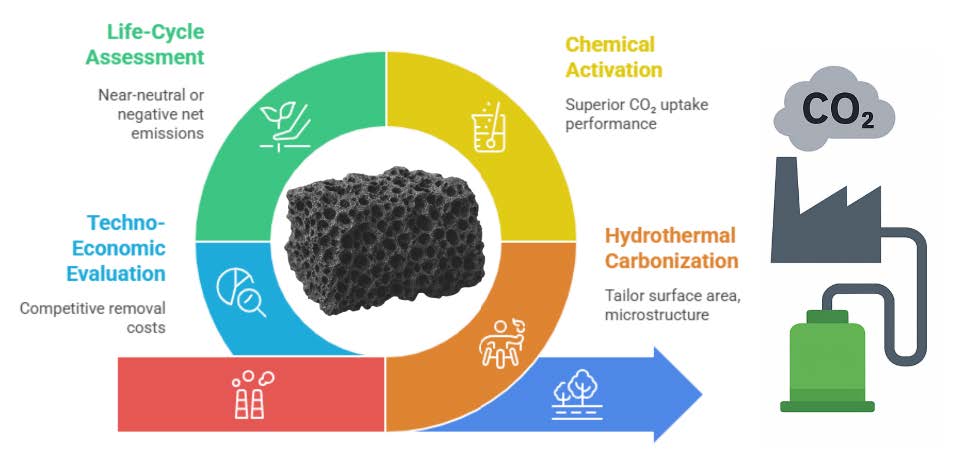
Biomass-derived carbon materials are gaining prominence as next-generation sorbents for low-carbon and economically viable CO2 capture, owing to their tunable architectures, renewable origins, and strong life-cycle advantages. Much like transforming raw clay into a finely crafted ceramic through controlled firing, these materials evolve through carefully designed synthesis and activation routes that dictate their pore structure, surface chemistry, and ultimately their adsorption performance. This review consolidates recent advances in the mechanisms, synthesis pathways, activation methodologies, and sustainability considerations, shaping their development within integrated carbon capture systems. Hydrothermal carbonisation (HTC) in the 200°C to 260°C range plays a critical role in tailoring surface area and microstructure. The chemical activation consistently delivers superior performance, averaging CO2 uptake values of 2.86 mmol/g, notably higher than 1.85 mmol/g obtained via physical activation. Life-cycle assessments highlight the potential for near-neutral or even negative net emissions, particularly when biomass residues are utilised as the energy source for activation. Techno-economic evaluations further reveal competitive removal costs that outperform those of conventional amine-based systems, driven by lower regeneration energy requirements and reduced capital costs. Collectively, this review uniquely integrates mechanistic understanding, activation-performance benchmarking, and sustainability evidence to establish clear design and deployment pathways for biomassderived carbons in integrated carbon capture systems.
References
Abubakar, I., Saeed, MD., & Ayuba, AM. (2024). Physicochemical properties of biochar prepared from guinea corn straw as a function of different pyrolysis temperatures. Journal of Environmental Science and Agricultural Research, 1-8. https://doi.org/10.61440/JESAR.2024.v2.37 DOI: https://doi.org/10.61440/JESAR.2024.v2.37
Antero, R. V. P., Alves, A. C. F., de Oliveira, S. B., Ojala, S. A., & Brum, S. S. (2020). Challenges and alternatives for the adequacy of hydrothermal carbonization of lignocellulosic biomass in cleaner production systems: A review. Journal of Cleaner Production, 252, 119899. https://doi.org/10.1016/j.jclepro.2019.119899 DOI: https://doi.org/10.1016/j.jclepro.2019.119899
Banerjee, T., Bravo, J., Romero, C. E., Lowe, T., Driscoll, G., Kreglow, B., Schobert, H., & Yao, Z. (2024). Process design and techno-economic analysis of activated carbon derived from anthracite coal. Journal of Environmental Management, 355, 120525. https://doi.org/10.1016/j.jenvman.2024.120525 DOI: https://doi.org/10.1016/j.jenvman.2024.120525
Cao, Z., Hülsemann, B., Wüst, D., Oechsner, H., Lautenbach, A., & Kruse, A. (2021). Effect of residence time during hydrothermal carbonization of biogas digestate on the combustion characteristics of hydrochar and the biogas production of process water. Bioresource Technology, 333, 125110. https://doi.org/10.1016/j.biortech.2021.125110 DOI: https://doi.org/10.1016/j.biortech.2021.125110
Carrascal-Hernández, D. C., Grande-Tovar, C. D., Mendez-Lopez, M., Insuasty, D., García-Freites, S., Sanjuan, M., & Márquez, E. (2025). CO2 capture: A comprehensive review and bibliometric analysis of scalable materials and sustainable solutions. Molecules, 30(3), 563. https://doi.org/10.3390/molecules30030563 DOI: https://doi.org/10.3390/molecules30030563
Cavali, M., Libardi Junior, N., de Sena, J. D., Woiciechowski, A. L., Soccol, C. R., Belli Filho, P., Bayard, R., Benbelkacem, H., & de Castilhos Junior, A. B. (2023). A review on hydrothermal carbonization of potential biomass wastes, characterization and environmental applications of hydrochar, and biorefinery perspectives of the process. Science of The Total Environment, 857, 159627. https://doi.org/10.1016/j.scitotenv.2022.159627 DOI: https://doi.org/10.1016/j.scitotenv.2022.159627
Chaves Fernandes, B. C., Ferreira Mendes, K., Dias Júnior, A. F., da Silva Caldeira, V. P., da Silva Teófilo, T. M., Severo Silva, T., Mendonça, V., de Freitas Souza, M., & Valadão Silva, D. (2020). Impact of pyrolysis temperature on the properties of eucalyptus wood-derived biochar. Materials, 13(24), 5841. https://doi.org/10.3390/ma13245841 DOI: https://doi.org/10.3390/ma13245841
Creamer, A. E., & Gao, B. (2016). Carbonbased adsorbents for postcombustion CO2 capture: A critical review. Environmental Science & Technology, 50(14), 7276-7289. https://doi.org/10.1021/acs.est.6b00627 DOI: https://doi.org/10.1021/acs.est.6b00627
Dan, E., McCue, A. J., & Martín, C. F. (2024). Biomass-derived materials for carbon capture: A review. In Reference module in materials science and materials engineering. Elsevier. https://doi.org/10.1016/B978-0-443-29210-1.00002-9 DOI: https://doi.org/10.1016/B978-0-443-29210-1.00002-9
Demiral, H., & Demiral, İ. (2018). Preparation and characterization of carbon molecular sieves from chestnut shell by chemical vapor deposition. Advanced Powder Technology, 29(12), 3033-3039. https://doi.org/10.1016/j.apt.2018.07.015 DOI: https://doi.org/10.1016/j.apt.2018.07.015
Dissanayake, P. D., You, S., Igalavithana, A. D., Xia, Y., Bhatnagar, A., Gupta, S., Kua, H. W., Kim, S., Kwon, J.-H., Tsang, D. C. W., & Ok, Y. S. (2020). Biochar-based adsorbents for carbon dioxide capture: A critical review. Renewable and Sustainable Energy Reviews, 119, 109582. https://doi.org/10.1016/j.rser.2019.109582 DOI: https://doi.org/10.1016/j.rser.2019.109582
Djandja, O. S., Liew, R. K., Liu, C., Liang, J., Yuan, H., He, W., Feng, Y., Lougou, B. G., Duan, P.-G., Lu, X., & Kang, S. (2023). Catalytic hydrothermal carbonization of wet organic solid waste: A review. Science of The Total Environment, 873, 162119. https://doi.org/10.1016/j.scitotenv.2023.162119 DOI: https://doi.org/10.1016/j.scitotenv.2023.162119
Dobele, G., Volperts, A., Plavniece, A., Zhurinsh, A., Upskuviene, D., Balciunaite, A., Niaura, G., Colmenares-Rausseo, L. C., Tamasauskaite-Tamasiunaite, L., & Norkus, E. (2024). Thermochemical activation of wood with NaOH, KOH and H3PO4 for the synthesis of nitrogen-doped nanoporous carbon for oxygen reduction reaction. Molecules, 29(10), 2238. https://doi.org/10.3390/molecules29102238 DOI: https://doi.org/10.3390/molecules29102238
Elhenawy, S. E. M., Khraisheh, M., AlMomani, F., & Walker, G. (2020). Metal-organic frameworks as a platform for CO2 capture and chemical processes: Adsorption, Membrane separation, catalyticconversion, and electrochemical reduction of CO2. Catalysts, 10(11), 1293. https://doi.org/10.3390/catal10111293 DOI: https://doi.org/10.3390/catal10111293
Forse, A. C., & Milner, P. J. (2021). New chemistry for enhanced carbon capture: Beyond ammonium carbamates. Chemical Science, 12(2), 508-516. https://doi.org/10.1039/D0SC06059C DOI: https://doi.org/10.1039/D0SC06059C
Goel, C., Mohan, S., & Dinesha, P. (2021). CO2 capture by adsorption on biomass-derived activated char: A review. Science of The Total Environment, 798, 149296. https://doi.org/10.1016/j.scitotenv.2021.149296 DOI: https://doi.org/10.1016/j.scitotenv.2021.149296
Guo, D., Shibuya, R., Akiba, C., Saji, S., Kondo, T., & Nakamura, J. (2016). Active sites of nitrogen-doped carbon materials for oxygen reduction reaction clarified using model catalysts. Science, 351(6271), 361-365. https://doi.org/10.1126/science.aad0832 DOI: https://doi.org/10.1126/science.aad0832
Hanif, A., Aziz, M. A., Helal, A., Abdelnaby, M. M., Khan, A., Theravalappil, R., & Khan, M. Y. (2023). CO2 adsorption on biomassderived carbons from Albizia procera leaves: Effects of synthesis strategies. ACS Omega, 8(39), 36228-36236. https://doi.org/10.1021/acsomega.3c04693 DOI: https://doi.org/10.1021/acsomega.3c04693
Haykiri-Acma, H., & Yaman, S. (2009). Effect of the heating rate on the morphology of the pyrolytic char from hazelnut shell. International Journal of Green Energy, 6(5), 508-511. https://doi.org/10.1080/15435070903228167 DOI: https://doi.org/10.1080/15435070903228167
Ighalo, J. O., Rangabhashiyam, S., Dulta, K., Umeh, C. T., Iwuozor, K. O., Aniagor, C. O., Eshiemogie, S. O., Iwuchukwu, F. U., & Igwegbe, C. A. (2022). Recent advances in hydrochar application for the adsorptive removal of wastewater pollutants. Chemical Engineering Research and Design, 184, 419-456. https://doi.org/10.1016/j.cherd.2022.06.028 DOI: https://doi.org/10.1016/j.cherd.2022.06.028
Ji, Y., Zhang, C., Zhang, X. J., Xie, P. F., Wu, C., & Jiang, L. (2022). A high adsorption capacity bamboo biochar for CO2 capture for low temperature heat utilization. Separation and Purification Technology, 293, 121131. https://doi.org/10.1016/j.seppur.2022.121131 DOI: https://doi.org/10.1016/j.seppur.2022.121131
Kumar, R., Strezov, V., Weldekidan, H., He, J., Singh, S., Kan, T., & Dastjerdi, B. (2020). Lignocellulose biomass pyrolysis for bio-oil production: A review of biomass pre-treatment methods for production of drop-in fuels. Renewable and Sustainable Energy Reviews, 123, 109763. https://doi.org/10.1016/j.rser.2020.109763 DOI: https://doi.org/10.1016/j.rser.2020.109763
Kundu, S., Khandaker, T., Anik, M. A.-A. M., Hasan, M. K., Dhar, P. K., Dutta, S. K., Latif, M. A., & Hossain, M. S. (2024). A comprehensive review of enhanced CO2 capture using activated carbon derived from biomass feedstock. RSC Advances, 14(40), 29693-29736. https://doi.org/10.1039/D4RA04537H DOI: https://doi.org/10.1039/D4RA04537H
Leventaki, E., Queiroz, E. C., Pisharody, S. K., Siva Kumar, A. K., Ho, P. H., Andersson-Sarning, M., Haase, B., Baena-Moreno, F. M., Cuin, A., & Bernin, D. (2024). Aqueous mineral carbonation of three different industrial steel slags: Absorption capacities and product characterization. Environmental Research, 252, 118903. https://doi.org/10.1016/j.envres.2024.118903 DOI: https://doi.org/10.1016/j.envres.2024.118903
Linares-Solano, A., Salinas-Martínez de Lecea, C., Cazorla-Amorós, D., & Martín-Gullón, I. (2000). Porosity development during CO2 and steam activation in a fluidized bed reactor. Energy & Fuels, 14(1), 142-149. https://doi.org/10.1021/ef9900637 DOI: https://doi.org/10.1021/ef9900637
Mohd Azmi, N. Z., Buthiyappan, A., Abdul Raman, A. A., Abdul Patah, M. F., & Sufian, S. (2022). Recent advances in biomass based activated carbon for carbon dioxide capture – A review. Journal of Industrial and Engineering Chemistry, 116, 1-20. https://doi.org/10.1016/j.jiec.2022.08.021 DOI: https://doi.org/10.1016/j.jiec.2022.08.021
Montes-Morán, M. A., Suárez, D., Menéndez, J. A., & Fuente, E. (2004). On the nature of basic sites on carbon surfaces: An overview. Carbon, 42(7), 1219-1225. https://doi.org/10.1016/j.carbon.2004.01.023 DOI: https://doi.org/10.1016/j.carbon.2004.01.023
Muzyka, R., Misztal, E., Hrabak, J., Banks, S. W., & Sajdak, M. (2023). Various biomass pyrolysis conditions influence the porosity and pore size distribution of biochar. Energy, 263, 126128. https://doi.org/10.1016/j.energy.2022.126128 DOI: https://doi.org/10.1016/j.energy.2022.126128
Nazir, G., Rehman, A., Hussain, S., Mahmood, Q., Fteiti, M., Heo, K., Ikram, M., & Aizaz Ud Din, M. (2023). Towards a sustainable conversion of biomass/biowaste to porous carbons for CO2 adsorption: Recent advances, current challenges, and future directions. Green Chemistry, 25(13), 4941-4980. https://doi.org/10.1039/D3GC00636K DOI: https://doi.org/10.1039/D3GC00636K
Nowrouzi, M., Abyar, H., Younesi, H., & Khaki, E. (2021). Life cycle environmental and economic assessment of highly efficient carbon-based CO2 adsorbents: A comparative study. Journal of CO2 Utilization, 47, 101491. https://doi.org/10.1016/j.jcou.2021.101491 DOI: https://doi.org/10.1016/j.jcou.2021.101491
Patel, H., Mohanty, A., & Misra, M. (2024). Post-combustion CO2 capture using biomass based activated porous carbon: Latest advances in synthesis protocol and economics. Renewable and Sustainable Energy Reviews, 199, 114484. https://doi.org/10.1016/j.rser.2024.114484 DOI: https://doi.org/10.1016/j.rser.2024.114484
Quan, C., Zhou, Y., Wang, J., Wu, C., & Gao, N. (2023). Biomass-based carbon materials for CO2 capture: A review. Journal of CO2 Utilization, 68, 102373. https://doi.org/10.1016/j.jcou.2022.102373 DOI: https://doi.org/10.1016/j.jcou.2022.102373
Saleem, J., Khalid Baig Moghal, Z., Tahir, F., Al-Ansari, T., Osman, A. I., & McKay, G. (2025). Life cycle assessment of high value activated carbon production based on mass and functional performance metrics. Scientific Reports, 15(1), 32797. https://doi.org/10.1038/s41598-025-16300-1 DOI: https://doi.org/10.1038/s41598-025-16300-1
Samsudin, M. H., Mohd Yusoff, M. Z., Roslan, A. M., Hassan, M. A., Idris, J., Ahmad Farid, M. A., & Yoshihito, S. (2025). Economic evaluation of woodchip-derived bio-adsorbent production: A case study using a self-sustained pilot-scale pooltype carbonization reactor. Environmental Science and Pollution Research, 32(34), 20414-20426. https://doi.org/10.1007/s11356-025-36859-6 DOI: https://doi.org/10.1007/s11356-025-36859-6
Santos, J. L., Centeno, M. A., & Odriozola, J. A. (2023). Biochar production from cellulose under reductant atmosphere: Influence of the total pyrolysis time. RSC Advances, 13(30), 21071-21079. https://doi.org/10.1039/D3RA03093H DOI: https://doi.org/10.1039/D3RA03093H
Senadheera, S. S., Withana, P. A., Lim, J. Y., You, S., Chang, S. X., Wang, F., Rhee, J. H., & Ok, Y. S. (2024). Carbon negative biochar systems contribute to sustainable urban green infrastructure: A critical review. Green Chemistry, 26(21), 10634-10660. https://doi.org/10.1039/D4GC03071K DOI: https://doi.org/10.1039/D4GC03071K
Shafizadeh, A., Shahbeik, H., Rafiee, S., Moradi, A., Shahbaz, M., Madadi, M., Li, C., Peng, W., Tabatabaei, M., & Aghbashlo, M. (2023). Machine learningbased characterization of hydrochar from biomass: Implications for sustainable energy and material production. Fuel, 347, 128467. https://doi.org/10.1016/j.fuel.2023.128467 DOI: https://doi.org/10.1016/j.fuel.2023.128467
Sharma, P. P., Wu, J., Yadav, R. M., Liu, M., Wright, C. J., Tiwary, C. S., Yakobson, B. I., Lou, J., Ajayan, P. M., & Zhou, X. (2015). Nitrogen‐doped carbon nanotube arrays for high‐efficiency electrochemical reduction of CO2: On the understanding of defects, defect density, and selectivity. Angewandte Chemie International Edition, 54(46), 13701-13705. https://doi.org/10.1002/anie.201506062 DOI: https://doi.org/10.1002/anie.201506062
Shi, W., Yu, J., Liu, H., Gao, D., Yuan, A., & Chang, B. (2023). Hierarchically nanoporous carbon for CO2 capture and separation: Roles of morphology, porosity, and surface chemistry. ACS Applied Nano Materials, 6(9), 7887-7900. https://doi.org/10.1021/acsanm.3c01040 DOI: https://doi.org/10.1021/acsanm.3c01040
Shibuya, R., Takeyasu, K., Guo, D., Kondo, T., & Nakamura, J. (2022). Chemisorption of CO2 on nitrogen-doped graphitic carbons. Langmuir, 38(47), 14430-14438. https://doi.org/10.1021/acs.langmuir.2c01987 DOI: https://doi.org/10.1021/acs.langmuir.2c01987
Singh, G., Lakhi, K. S., Sil, S., Bhosale, S. V., Kim, I., Albahily, K., & Vinu, A. (2019). Biomass derived porous carbon for CO2 capture. Carbon, 148, 164-186. https://doi.org/10.1016/j.carbon.2019.03.050 DOI: https://doi.org/10.1016/j.carbon.2019.03.050
Tasca, A. L., Puccini, M., Gori, R., Corsi, I., Galletti, A. M. R., & Vitolo, S. (2019). Hydrothermal carbonization of sewage sludge: A critical analysis of process severity, hydrochar properties and environmental implications. Waste Management, 93, 1-13. https://doi.org/10.1016/j.wasman.2019.05.027 DOI: https://doi.org/10.1016/j.wasman.2019.05.027
Umar, M., Yusuf, B. O., Aliyu, M., Hussain, I., Alhassan, A. M., Awad, M. M., Taialla, O. A., Ali, B., Alhooshani, K. R., & Ganiyu, S. A. (2025). Advancing frontiers in CO2 capture: The renaissance of biomassderived carbon materials. Coordination Chemistry Reviews, 526, 216380. https://doi.org/10.1016/j.ccr.2024.216380 DOI: https://doi.org/10.1016/j.ccr.2024.216380
Wang, T., Zhai, Y., Zhu, Y., Li, C., & Zeng, G. (2018). A review of the hydrothermal carbonization of biomass waste for hydrochar formation: Process conditions, fundamentals, and physicochemical properties. Renewable and Sustainable Energy Reviews, 90, 223-247. https://doi.org/10.1016/j.rser.2018.03.071 DOI: https://doi.org/10.1016/j.rser.2018.03.071
Whaieb, A. H., Jasim, F. T., Abdulrahman, A. A., Khuder, I. M., Gheni, S. A., Fattah, I. M. R., & Karakullukcu, N. T. (2025). Tailoring zeolites for enhanced post-combustion CO2 capture: A critical review. Current Research in Green and Sustainable Chemistry, 10, 100451. https://doi.org/10.1016/j.crgsc.2025.100451 DOI: https://doi.org/10.1016/j.crgsc.2025.100451
Yang, K., Peng, J., Xia, H., Zhang, L., Srinivasakannan, C., & Guo, S. (2010). Textural characteristics of activated carbon by single step CO2 activation from coconut shells. Journal of the Taiwan Institute of Chemical Engineers, 41(3), 367-372. https://doi.org/10.1016/j.jtice.2009.09.004 DOI: https://doi.org/10.1016/j.jtice.2009.09.004
Yuan, X., Wang, J., Deng, S., Dissanayake, P. D., Wang, S., You, S., Yip, A. C. K., Li, S., Jeong, Y., Tsang, D. C. W., & Ok, Y. S. (2022). Sustainable food waste management: Synthesizing engineered biochar for CO2 capture. ACS Sustainable Chemistry & Engineering, 10(39), 13026-13036. https://doi.org/10.1021/acssuschemeng.2c03029 DOI: https://doi.org/10.1021/acssuschemeng.2c03029
Yurduşen, A., Yürüm, A., & Yürüm, Y. (2020). The role of ultramicropores in the CO2 adsorption capacity of Fe–BTC crystallites synthesized with a perturbationassisted nanofusion synthesis strategy. CrystEngComm, 22(5), 932-944. https://doi.org/10.1039/C9CE01626K DOI: https://doi.org/10.1039/C9CE01626K
Zentou, H., Hoque, B., Abdalla, M. A., Saber, A. F., Abdelaziz, O. Y., Aliyu, M., Alkhedhair, A. M., Alabduly, A. J., & Abdelnaby, M. M. (2025). Recent advances and challenges in solid sorbents for CO2 capture. Carbon Capture Science & Technology, 15, 100386. https://doi.org/10.1016/j.ccst.2025.100386 DOI: https://doi.org/10.1016/j.ccst.2025.100386
Zhang, L., Wang, Q., Xu, F., Wang, Z., & Zhang, G. (2022). Insights into the evolution of chemical structures in hydrochars from hydrothermal carbonization of PVC. Journal of the Energy Institute, 105, 323-333. https://doi.org/10.1016/j.joei.2022.09.004 DOI: https://doi.org/10.1016/j.joei.2022.09.004
Downloads
Published
How to Cite
Issue
Section
License
Copyright (c) 2026 Planetary Sustainability

This work is licensed under a Creative Commons Attribution-ShareAlike 4.0 International License.